
 April 2026 Advocacy Champion
Magda A. Bushara, MBBS, FACP
Internal Medicine
Park Nicollet Clinic and Specialty Center, St. Louis Park
1. Why is being an advocate so important to you?
As a physician, I can be one of many who provide a voice for the voiceless in healthcare, health policy, and health equity. Being an advocate allows me to participate in activities which align with my goals and values - I am passionate about my field, internal medicine, health care delivery, and considering the whole person, including factors outside of clinic, which affect one’s health. I believe that achieving health equity and speaking up against injustices that lead to health disparities is an integral part of my role as a physician, and does not adversely affect any patient nor demographic. To the contrary, “we all do better when we all do better,” in the words of the late Paul Wellstone. Social justice, access to healthcare, education, green space, transportation and food security, reproductive freedom and rights, are all important determinants of health. Keeping these factors in mind is a strong motivator for me to work towards a local community, state, country, and world, which will be better for future generations.
2. What healthcare related issue(s) have you advocated for over the past year?
As a member of the MMA, ACP, AMA, MDHEQ, and our organization’s Colorectal Cancer Screening Workgroup, I am grateful and energized to be working with so many people who are like-minded. I recently attended the American Medical Association’s National Advocacy Conference in Washington DC, where we met some of our Minnesota members of Congress, advocating on crucial healthcare issues affecting patients and physicians. This year’s topics included Medicare, prior authorization, Medicaid, requesting IMG’s be excluded from the $100,000 H-1B visa fee, and holding DHS accountable for ensuring that ICE detainees are provided with appropriate medical care, food, water, medications, and other basic human needs.
Many physicians and organizations signed the NEJM letter to the editor[JM1.1], We Do Care, February, 2026, in which we called for an immediate end to the violence and trauma which is being inflicted on our patients and communities by ICE.
In February of this year, I visited an immigrant family from Central America who had been in hiding since November 2025. The young mother delayed seeking healthcare due to the presence of ICE in and around healthcare facilities. Her recurrent abdominal pain became so severe she sought care in the ED, and ultimately ended up needing an emergency colostomy as she had a tumor causing obstruction. I could imagine the pain she had endured leading up to her surgery as I experienced intestinal obstruction during the summer of 2024, the cause in my case was intestinal DLBCL. I started chemotherapy 11/2024, and am thankfully in remission. When I met this young mother, arrangements were made for her to be escorted by White drivers to her appointment the following week for port placement so that she can start chemotherapy. Meanwhile, her daughter missed days of school whenever ICE cars were in their apartment complex parking lot, and her 6-month-old son had already missed his well child visit and vaccinations. The unnecessary cruelty and inhumanity of their situation, and too many others, demanded action. I was grateful to one of several chat groups which provided information for a mobile pediatric clinic, and her son was soon able to receive healthcare.
As a colorectal cancer screening workgroup member, one of our main goals is to reduce disparities in colorectal cancer screening rates, with the ultimate goal of reducing morbidity and mortality from colon cancer through early detection, and potentially prevention of CRC through removal of adenomatous colonic polyps during screening colonoscopies.
As I am certain many others have done this past year, I have made many phone calls to our representatives in Congress to urge the rejection of any measure which adversely affects health, healthcare, education, housing, SNAP, research funding, veterans, and many other important legislative issues, and thanked our representatives for their service.
3. What advice would you offer to others who are interested in advocacy?
Definitely get involved! Connect your passion to action by finding a group of like-minded individuals (or create your own!) for mutual support, ideas, and action. Support organizations and political candidates whose goals are in tune with yours, and who are contributing to positive changes which you envision as being important to the current and future state of healthcare. Becoming a member of organizations such as MMA, ACP, AMA, MDHEQ, and many others which are active in advocacy for your patients, healthcare policy, and your field, will be energizing, and your voices are needed!
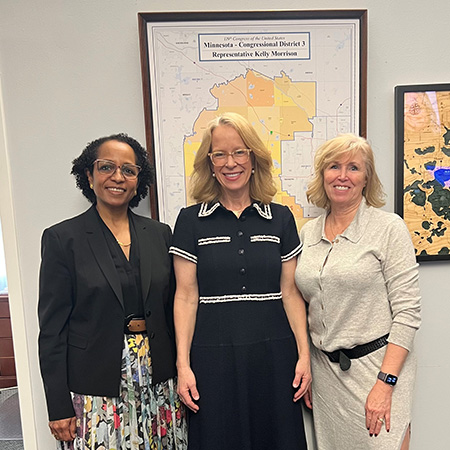
(Pictured: Magda A. Bushara, MBBS, FACP (left) with Rep. Kelly Morrison, MD, and MMA President Lisa Mattson, MD)
October 2026
September 2026
August 2026
July 2026
June 2026
May 2026
April 2026
March 2026
February 2026
January 2026
December 2025
November 2025