MMA Leaders Testify on Medicaid Cuts
February 19, 2026
On the second day of the legislative session, MMA leadership was already advocating for one of its top priorities - minimizing the harm of federal changes to Medical Assistance (MA).
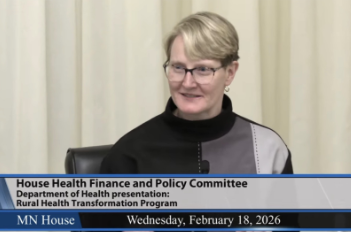
MMA President-elect Dania Kamp, MD, testified before the House Health Finance and Policy Committee hearing on February 18. At the hearing, the Minnesota Department of Health shared information about the Rural Health Transformation Program (RHTP), a federally funded program that awarded $193 million to Minnesota to address healthcare in rural areas.
“As a rural physician, the funds awarded under the RHTP come at a most critical time for my patients, and all those in Greater Minnesota,” Kamp testified. “However, I would be remiss not to note how other federal policy is expected to affect the health of rural Minnesotans.”
 |
|
MMA President-elect Dania Kamp, MD, testified before the House Health Finance and Policy Committee.
|
Kamp went on to explain how federal Medicaid support to Minnesota will be reduced by approximately $1.4 billion annually following the passage of House Resolution 1 (H.R.1), “the One Big Beautiful Bill,” last summer. Roughly 45% of MA enrollees live outside of the seven-county metro area, and 550,000 rural Minnesotans depend on MA for their care. Following the passage of H.R. 1, the nonpartisan Congressional Budget Office estimates that up to 140,000 Minnesotans will lose MA coverage over the next 10 years.
To combat these federal cuts, Kamp argued that Minnesota needs to invest RHTP funds into training more physicians to work in rural areas. She argued that, on top of federal funding cuts, new federal loan caps for professional students will disproportionately hurt rural patients. Beginning July 1 of this year, medical students will face a $50,000 annual cap and a $200,000 lifetime cap on federal borrowing. Many physicians-in-training rely on these loans to fund their education, and most physicians borrow more than the $200,000 cap.
Physician shortages in rural Minnesota will be compounded by these caps. Rural communities have roughly one primary care physician for every 2,700 residents. In comparison, those in the metro area have one for every 965 residents. Rural physicians are older on average, and nearly one in four plan to leave practice within five years. The caps on federal borrowing, paired with low reimbursement rates, demographic shifts, and increased rates of physician burnout, will all lead to fewer physicians in rural areas.
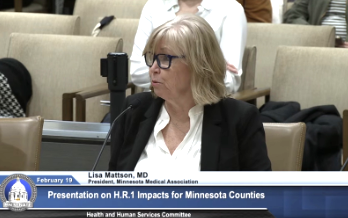
Concerns over federal Medicaid cuts were echoed by MMA President Lisa Mattson, MD, before the Senate Health and Human Services Committee on February 19.
“When coverage becomes unaffordable, people do not stop needing medical care,” Mattson said. “People delay treatment and eventually go to emergency departments. That places additional strain on clinics and hospitals, increases costs across the healthcare system, and most importantly, results in overall worse health outcomes for patients.”
 |
|
MMA President Lisa Mattson, MD, shares the impacts of federal Medicaid cuts before the Senate Health and Human Services Committee.
|
In her testimony, Mattson referenced the discontinuation of enhanced premium tax credits to make coverage more affordable for thousands of Minnesotans purchasing insurance through MNsure. As those enhanced subsidies expire, about 62% of MNsure enrollees – roughly 89,000 Minnesotans – are expected to see their financial assistance reduced, and nearly 19,000 may lose assistance entirely.
“I urge lawmakers to carefully consider the downstream impacts of these federal changes,” Mattson said, “and to prioritize state-level strategies to protect patient access, preserve physician workforce development, and maintain the strength of Minnesota’s healthcare system.”